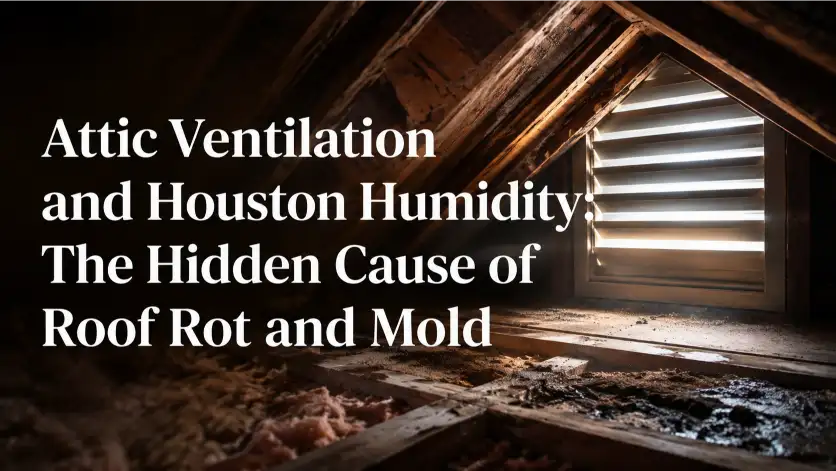
Last summer we were up in an attic off West Road in Cypress. The homeowner had called about a small leak near the chimney flashing. We fixed the flashing in twenty minutes. But before we came down, one of our guys pressed his hand against the underside of the decking near the ridge. It gave. Not much, but enough. We kept looking. The rafters had dark gray streaking across the grain. The nail heads coming through the boards had turned orange.
The roof from the outside looked fine. No missing shingles, no obvious damage. The leak was real but minor. The rot and mold had nothing to do with the leak. They came from something the homeowner had no idea was happening, a Houston attic ventilation problem that had been quietly building for years before we got there.
QUICK ANSWER
Attic mold in Houston rarely comes from a roof leak. It comes from warm, humid air rising from inside your home and condensing on the underside of your roof decking every night. With Houston’s humidity sitting above 75% most of the year, an attic that can’t move air gives that moisture nowhere to go. Over time, it feeds mold on the wood surfaces and eventually starts breaking down the decking itself.
The early signs you can check yourself: dark gray or black streaking on the rafters, rust on the nail heads coming through the decking, and a musty smell that’s there even when nothing looks wet. Bustamante Roofing’s free roof inspection includes an attic ventilation check as part of its standard scope. If something doesn’t look right up there, call us at (346) 234-3057.
Why Houston Is Harder on Attics Than Almost Anywhere Else
Walk into an unventilated Houston attic in August, and you’ll understand immediately. The temperature up there runs between 130 and 150°F on a hot afternoon. That’s not uncomfortable. That’s dangerous. You can feel the decking radiating heat before you even touch it.
Most cities with humid summers get a break in the evening. Temperatures drop, dew points ease, and the attic gets some relief. Houston doesn’t work that way. The Gulf pushes moisture in constantly. The city sits at essentially sea level with almost no elevation to break the airflow. Dew points in July and August routinely stay above 75°F through the night, which means the air in your attic never fully dries out between cycles.
The result is a daily heat-and-moisture loop. The attic heats to extreme temperatures during the day. At night it cools, and any moisture suspended in that hot air condenses out onto the wood surfaces. Then the cycle runs the next day again. And the day after that. For months at a stretch, from roughly April through October in the Houston area.
Atlanta and New Orleans have similar humidity numbers. But neither gets the sustained combination of 100°F+ heat AND near-constant coastal moisture that Greater Houston faces through seven months. It’s that combination, not the humidity alone, that makes Houston attics a fundamentally different problem from what most roofing standards were built around.
Pre-2010 homes across Cypress, Copperfield, Katy, and the Westchase corridor were built to code requirements that made sense at the time. They weren’t built for what we now understand about Houston’s actual climate load on an attic.
The Real Reason Attic Mold Grows Without a Roof Leak
Most homeowners assume a dry roof means a dry attic. Attic mold catches people by surprise almost every time we find it. Your roof keeps rain out. That’s its job, and a good roof does it well. But your attic moisture problem isn’t coming from above. It’s coming from below, from inside your own house, every single day.
Think about how many sources push warm, humid air upward in a Houston home. Your kitchen runs exhaust. Your bathrooms generate steam. Your HVAC system conditions the air but leaves gaps around every ceiling penetration. Recessed lights, the attic hatch, openings where ductwork rises, and spaces around partition wall tops all let conditioned indoor air drift into the attic. In the summer, that air enters an attic running at 130°F or hotter. Hot air holds moisture. Then the attic cools down after sunset. As the temperature drops, the air loses its ability to hold all that moisture, and water vapor condenses out onto whatever surfaces it touches. The underside of the roof decking. The face of the rafters. The nail heads.
Your roof is not leaking. Water is forming on the wood from inside the air itself. Without ventilation pulling that moisture out and replacing it with drier outside air, the condensation happens again the next night. And the night after that. Wood surfaces that stay wet long enough grow mold. Wood that stays wet even longer starts to rot. The decking softens. The structural rating of that wood drops. By the time anyone goes up there to look, the damage has usually been building for a year or two, sometimes longer.
We’ve pulled back insulation in Bellaire and Spring Branch attics where the homeowner had no idea. The roof was solid. The shingles were fine. The decking was coming apart from underneath because nothing had been moving that moisture out for years.

What to Look for When You Go Up There
Grab a flashlight. The signs are visible before anything costs you money.
Dark Gray or Black Streaking on the Rafters or Decking
The streaking looks like water stains, but water stains are brown or yellowish. What you’re looking for runs gray or black, and it follows the grain of the wood rather than dripping down from a single spot. Press it with your finger. If it wipes off like dust, it’s probably dirt. If the color stays in the wood, it’s likely mold. It’s already growing, and the sooner someone looks at it, the easier it is to fix.
Soft or Spongy Spots When You Press the Decking
Reach up and push against the underside of the decking between the rafters. Solid decking has no give. None. If it flexes even slightly under hand pressure, the wood fiber has started breaking down from moisture. We’ve found spots in Katy and Copperfield that looked fine visually and had lost most of their structural strength underneath. By the time decking goes soft, the rot has usually been working for a couple of years.
Rust on the Nail Heads Coming Through the Decking
The nails that hold your decking to the rafters poke through the underside. In a dry attic, they stay bare metal. Orange or brown rust on nail heads is a reliable early warning sign. It means moisture has been sitting in the attic long enough to corrode the metal. If nothing changes, mold often follows. The good news is that catching the problem at this stage usually means the wood is still sound.
Bubbling or Separation in the Decking Boards
OSB decking is the pressed-wood panel used in most Houston homes. It starts to delaminate after repeated moisture exposure. You might notice the surface layer bubbling slightly or a gap forming where two boards meet that wasn’t there before. Plywood does something similar: the layers start to separate at the edges. Push on a bubbled spot, and it’ll feel hollow. At this stage, the decking needs replacement before a new roof goes on.

A Musty Smell Even When Nothing Looks Wet
Mold produces a smell before it produces visible staining. If you go into the attic and it smells damp and earthy, not like dust or insulation but something organic, mold is already growing somewhere up there. The smell usually comes from mold on the back side of the decking, where you can’t see it from below. Don’t ignore it because you can’t find a source.
Check Your Bathroom Exhaust Fans Before Anything Else
Before you spend a dollar on ventilation upgrades, go into your attic and look at where your bathroom exhaust fans terminate. Most people assume those fans vent to the outside. A lot of them don’t. The duct runs from the fan through the ceiling into the attic, and then it just… stops. It ends inside the attic space. Which means every shower in your house dumps moisture directly into the attic rather than exhausting it outside.
We found this on a job in Spring Branch. The homeowner had two bathroom fans and a kitchen exhaust that all terminated in the attic. The ridge vent was in decent shape. The soffits were only partially blocked. But the moisture load from three exhaust fans running daily was overwhelming whatever ventilation the attic had. The mold wasn’t from the ventilation design. It was from three pipes dumping steam into an enclosed space every morning.
Go up with your flashlight and find the flex duct coming from each bathroom. Follow it. If it connects to a duct that exits through the roof or a gable wall with a backdraft damper on the outside, you’re fine. If the duct ends in the attic, or ties into old flex duct that’s been disconnected from the exterior cap, that’s your moisture source. Fixing that alone sometimes resolves the problem without touching the ridge vents or soffits.
The same goes for older clothes dryer vents that were originally run into the attic. That’s code-prohibited now, but houses from the 1970s and 1980s in neighborhoods like Bellaire and Memorial had it done routinely. If you find it, it needs to exit the building.
What Proper Attic Ventilation Actually Does
Most Houston homes have some combination of ridge vents, soffit vents, gable vents, and sometimes turbine vents. Those spinning metal caps you see on rooftops across the city are turbine vents. A lot of homeowners see them from the driveway and assume the attic is ventilated.
A properly functioning system has two things: air coming in at the bottom and air going out at the top. The soffit vents, the screens along the underside of your eaves, pull cooler outside air into the attic. That air pushes the hot, moisture-laden air in the attic upward and out through the ridge vent at the peak. It runs continuously, uses no power, and works whether the wind is blowing or not because heat rises.
The most common reason this system fails in Houston is insulation. Blown-in insulation settles toward the edges of the attic over the years. When it piles up at the eaves, it covers the soffit vent openings from inside. The vents look fine from the driveway. Inside the attic, nothing moves through them. You’ve got an exhaust at the top with no intake at the bottom. That’s not ventilation. It pulls hot air in from any gap it can find instead of from the soffits.
Turbine vents work when the wind is blowing. In Houston in August, wind at roof level slows to almost nothing during the hot afternoon hours when the attic is hottest. A turbine sitting still on a windless day is just a hole in your roof with a cap on it. Solar attic fans solve that problem. They run on sunlight, so they work hardest when the attic needs the most ventilation. But a solar fan with blocked soffits pulls indoor conditioned air up through ceiling gaps rather than pulling from outside. The intake has to match the exhaust, or the system works against you.
Gable vents alone, the louvered openings on the triangular ends of the house, handle cross-ventilation but miss the majority of the attic volume. They create airflow in a narrow band across the center of the attic and leave dead zones near the eaves and along the ridge where heat and moisture accumulate.
How Poor Ventilation Shortens Your Roof’s Life
Shingles get cooked from two directions in Houston. The sun hits them from above. The heat trapped in an unventilated attic hits them from below. A standard asphalt shingle is rated for a certain number of years under normal conditions. Normal conditions assume the decking underneath stays at a temperature reasonably close to outside air. When the attic runs at 140°F all afternoon, the shingles are sitting on a surface radiating that heat back into them from underneath. The asphalt softens repeatedly. The granules that protect the surface loosen. You lose years off the roof before any storm touches it.
We inspected a house in the Westchase area a few years back. The roof was nine years old. The granule loss looked like a fifteen-year roof. The homeowner couldn’t figure out why. The attic had two small box vents for a 2,200 square foot home. Nine years of baking from below had aged those shingles faster than a decade of Houston storms.
The streaks you see running down the roof slope on a lot of Houston homes also connect to this. Those dark lines aren’t dirt. They’re algae feeding on the calcium in the shingles, and they grow faster where the roof stays warm and damp. Poor ventilation keeps the roof deck warm and slightly moist longer than it should stay that way each night. That’s the environment algae thrive in. The streaks are a surface symptom of what’s happening inside the attic.
The warranty angle matters too. GAF and Owens Corning both require balanced attic ventilation as a condition of their shingle warranties. Balanced means air coming in at the soffits and going out near the ridge. If you file a granule loss or premature failure claim and an inspector finds blocked soffits or no ridge ventilation, the claim gets denied. Bustamante is a GAF certified contractor, and we see this play out in claims regularly. A homeowner pays for a new roof, the shingles underperform, and the warranty doesn’t cover it because the attic wasn’t set up right underneath.
Does Insurance Cover Attic Mold from Ventilation Problems?
Most standard homeowners policies in Texas cover sudden and accidental damage. If a storm tears off a ridge vent and rain gets in for three weeks before anyone notices, that is usually an insurance claim. If a hailstorm cracks the vent cap and moisture builds up underneath, that may also qualify as a claim. But if insulation has blocked the soffit vents for eight years and mold has been growing the whole time, virtually every standard policy treats that as a maintenance issue rather than a covered loss. The insurance company calls it gradual deterioration, and gradual deterioration is your problem, not theirs.
If a storm hit your area in the past year or two and you haven’t had anyone look at your attic since, the damage picture is murkier. Storm damage to ventilation components, such as cracked vent caps, bent or dislodged ridge vents, and damaged soffit screens, can allow moisture into the attic much faster. If you document that storm damage before repairs begin, the resulting mold and decking damage may fall within your insurance claim. If you repair the vents without documenting the storm damage first, you’ve essentially closed the claim.
We handle insurance claims documentation as part of what we do at Bustamante. Before any repair starts, we photograph what’s there, establish what existed before the work, and put together the documentation your adjuster needs to evaluate the claim properly. If you’re in a situation where a recent storm may have contributed to attic damage, call us at (346) 234-3057 before anyone touches anything. The insurance claims assistance and storm damage pages on our site have more on how that process works.
CONCLUSION
The homeowner in that Cypress attic had no idea any of this was happening. The roof looked fine from the street. Nobody had been up there in years. By the time we pressed on that decking and felt it give, the rot had been working for at least two years.
That’s the part that gets people. It’s quiet. It doesn’t drip. It doesn’t show on the ceiling. It just builds. Bustamante Roofing has been doing this work in Houston for three generations. When our crew goes up for a free inspection, the attic is part of it. We check the ventilation, inspect the decking, look at the nail heads, and tell you what we actually found, not what sells a bigger job.
If you’re in Cypress, Katy, Copperfield, Bellaire, Spring, or anywhere in the Greater Houston area, call us at (346) 234-3057 or schedule your free roof inspection online. Same-day slots are available most weeks. The earlier we get up there, the more options you have.